
Undercarriage costs often eat up half of your total maintenance budget. I see many buyers guessing at replacement times, which leads to costly downtime 1 or wasted parts. Let’s fix this uncertainty.
To estimate service life, combine bench test data with specific field coefficients. Multiply the theoretical limit—often 4,000 hours for links—by a factor reflecting your soil type (0.6 for rock, 1.0 for clay) and maintenance discipline to get a realistic prediction.
In this guide, I will walk you through the exact formulas and variables I use at Dingtai to help clients like you predict wear and tear with precision.
What duty cycles should I assume for my fleet?
Many fleet managers assume one standard lifespan for all machines. This mistake leads to inventory shortages when a mining project wears out tracks twice as fast as expected.
You must categorize your fleet into specific application zones. Standard construction work usually allows for a baseline factor of 1.0, while mining requires a 1.5 to 2.0 loss coefficient, effectively cutting your expected hours in half compared to general earthmoving.
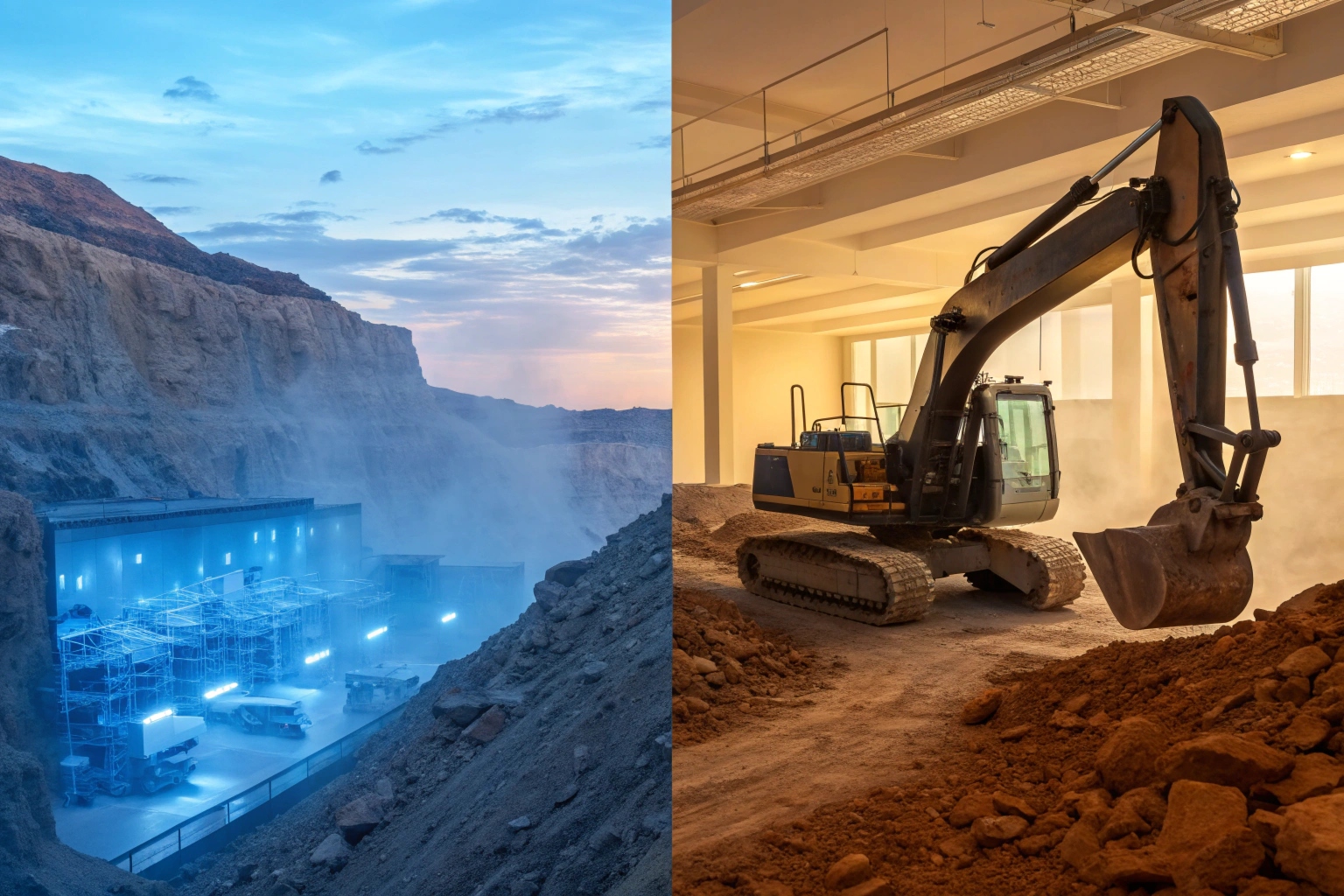
When we calculate service life at Dingtai, we do not just guess. We start with a "theoretical life." This comes from our bench tests. For example, we run a track link assembly 2 through a simulator for 1 million cycles to see how long the steel lasts under a perfect load. But you do not work in a lab. You work in the real world. To get a real number, you must apply a "Loss Coefficient" based on the duty cycle.
A duty cycle is not just about how many hours the engine is on. It is about what the machine is doing during those hours. We divide this into three main categories: Mining, Infrastructure, and Agriculture.
The Impact of Load and Travel
In mining, the machine is heavy. It carries heavy rock. The travel distance might be short, but the weight on the rollers is huge. This is a "High Impact" cycle. The steel does not just wear down; it cracks. This is why we use a coefficient of 1.5 to 2.0. If the lab says the part lasts 6,000 hours, in a mine, it might only last 3,000.
In infrastructure or road building, the work is more balanced. The machine digs, turns, and moves, but the soil is usually softer. The shock to the metal is lower. Here, the coefficient is 1.0 to 1.2. The part will last closer to its design life.
Calculating Your Specific Life
To get your number, use this simple formula:
Real Life = (Lab Test Life) ÷ (Duty Cycle Coefficient)
If you do not adjust for these duty cycles 3, your procurement plan will fail. You will buy parts for a 5,000-hour cycle, but your mining team will call you at 2,500 hours screaming for replacements.
| Application Type | Work Description | Loss Coefficient | Estimated Life (Base: 6000 hrs) |
|---|---|---|---|
| Agriculture/Soft Soil | Low abrasion, constant movement, light loads. | 0.8 – 1.0 | 6,000 – 7,500 Hours |
| General Infrastructure | Mixed soil/clay, standard digging, moderate travel. | 1.0 – 1.2 | 5,000 – 6,000 Hours |
| Quarry/Mining | High impact rock, heavy loads, uneven terrain. | 1.5 – 2.0 | 3,000 – 4,000 Hours |
Can I use wear indicators to track life?
Relying solely on hour meters is a gamble because different operators stress the machine differently. You need physical proof of wear to know when a failure is imminent.
Physical measurements are the only source of truth. By measuring the link pitch, bushing diameter, and grouser height against the manufacturer’s ‘100% worn’ dimension charts, you can calculate the exact percentage of life remaining regardless of the hour meter reading.
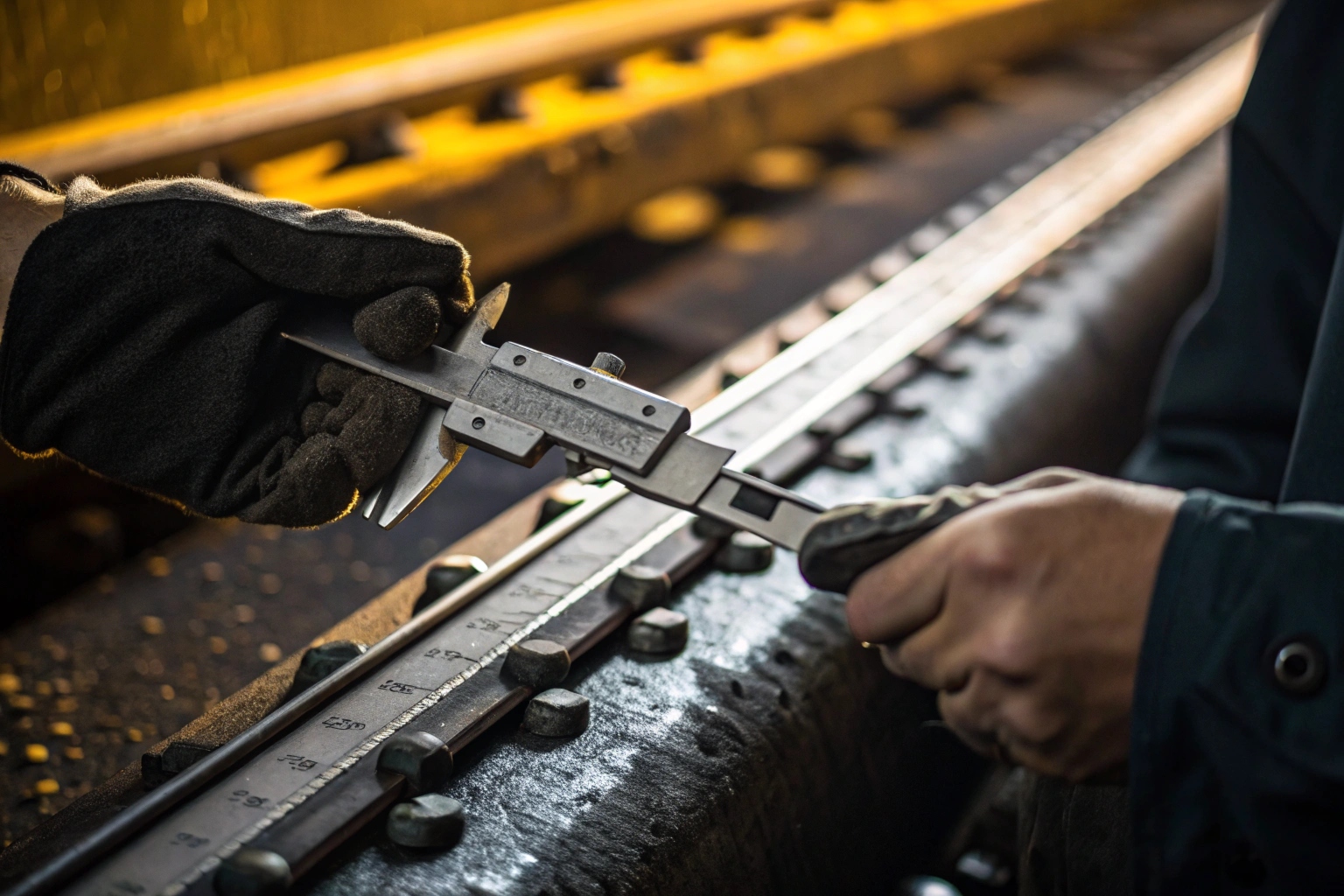
Many of my customers ask if they can trust the hour meter on the dashboard. I always say no. The hour meter only tells you how long the engine ran. It does not tell you if the machine walked 10 miles on concrete or stood still digging soft sand. To truly know when to order new parts, you must look at the steel itself.
The Critical Measurements
There are three main numbers you need to track. If you track these, you will never be surprised by a broken track.
- Link Pitch: This is the distance between the pins. As the internal pin and bushing wear out, the chain gets longer. We call this "pitch extension." When the link pitch 4 gets too long, the chain does not fit the sprocket anymore. It starts to climb up the teeth and snap them off.
- Bushing Outer Diameter (OD): The bushing is what touches the sprocket 5. If it wears down too much, the casing becomes thin and can crack.
- Grouser Height: This is the height of the "cleat" on the track shoe. In soft soil, this matters for traction. In rock, it matters for bending strength.
How to Interpret the Data
You cannot just look at it. You must measure it. Every manufacturer, including us at Dingtai, provides a "Wear Limit" chart.
For example, a new link pitch might be 190mm. The "100% worn" limit might be 195mm. If you measure 192.5mm, you are 50% through the life of that chain. This is a fact. The hour meter might say 2,000 hours or 5,000 hours, but the steel tells the true story.
You should perform these checks every 500 hours. This allows you to build a trend line. If you see the wear rate speed up, you know the ground conditions changed, and you can adjust your budget.
Functional vs. Structural Failure
You must also understand the difference between these two types of end-of-life.
- Functional Failure: The part is worn out, but still works. For example, the grousers 6 are smooth. The machine slides, but it moves.
- Structural Failure: The part breaks. The link cracks or the pin snaps. This stops the machine instantly.
Using wear indicators helps you predict functional failure so you can replace the part before it becomes a structural failure.
How do environment and operator habits affect life?
I have seen identical undercarriages last 6,000 hours for one client and fail at 3,000 for another. The difference wasn’t the steel; it was the soil and the driver.
Environmental abrasion and operator technique are the biggest variables. High-silica soil acts like grinding paste, reducing life by 40%, while an operator who frequently travels in reverse or spins tracks can accelerate bushing wear by over 50% within a single season.
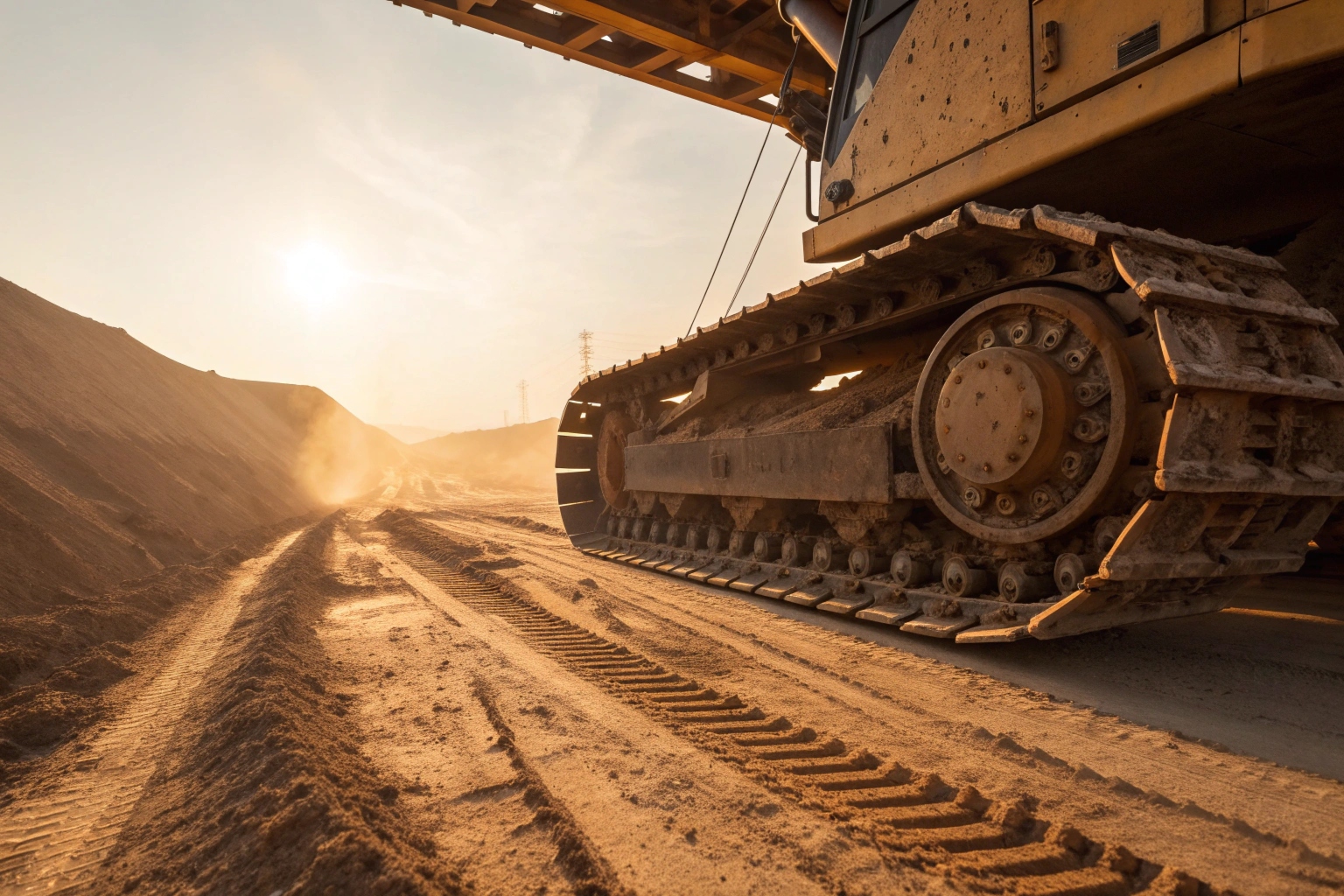
We can make the steel as hard as possible, but we cannot control the dirt or the driver. These two factors are the "silent killers" of undercarriage parts. When I analyze failed parts from the field, I can almost always tell if the operator was rough or if the soil was sandy.
The Soil Factor: The Silica Problem
Soil is not just dirt. It is a collection of minerals. The worst enemy of steel is silica 7 (sand). Silica is harder than steel. When wet sand gets between the bushing and the sprocket, it turns into a grinding paste. It acts like sandpaper.
If you work in sandy soil, your bushings will wear into an oval shape very fast. Even if the load is light, the abrasion removes the metal. In contrast, clay is soft. It acts like a lubricant. A machine working in clay might last 30% longer than the same machine working in sand.
The Operator Factor: The Reverse Travel Penalty
The way a driver moves the machine changes the stress points. The most common mistake is traveling in reverse. Excavator tracks are designed to pull the machine forward. When you travel forward, the load is on the thick part of the track link.
When you travel in reverse, the load shifts. The sprocket pulls directly against the bushing and the pin. This creates huge stress. We call this the "Reverse Travel Penalty." If an operator travels in reverse for long distances, they can cut the life of the bushings by half.
Another bad habit is pivot turning 8 or spinning the tracks in place on rock. This grinds the shoe grousers sideways. It can shear off the rubber seals in the rollers.
The Packing Effect
Finally, look at the environment’s ability to "pack." Mud or wet soil can pack inside the track frame. If this mud dries, it becomes as hard as cement. It stretches the chain tight. A tight chain increases the load on all parts by 50% or more. If the operator does not clean the undercarriage daily, this internal pressure will destroy the seals and bearings.
| Factor | Condition | Impact on Service Life |
|---|---|---|
| Soil Type | High Silica (Sand) | Reduces life by 30-50% (Abrasion) |
| Travel Direction | Frequent Reverse Travel | Reduces Bushing life by 40-50% |
| Turning Habit | Pivot Turns on Rock | Reduces Shoe/Grouser life by 30% |
| Maintenance | Mud Packing in Frame | Increases tension, reduces overall life by 25% |
Will the supplier warrant a minimum hours level?
Buyers often demand a flat 4,000-hour guarantee without reading the fine print. This approach leaves you unprotected when a claim is rejected due to "improper use" clauses.
A credible warranty is not a blanket promise but a conditional agreement. It should specify hour limits based on component type—typically 5,000 for rollers but less for shoes—and strictly exclude damages caused by track tension neglect or abnormal impact loads.

When you negotiate with a supplier like me, or anyone else, you need to understand what a warranty actually covers. A warranty is not an insurance policy against all wear. It is a guarantee against defects in manufacturing.
The Problem with Blanket Hour Warranties
If a supplier promises you "4,000 hours warranty" on everything, be careful. Different parts wear at different rates.
- Rollers usually last longer because they have oil inside and spin freely.
- Sprockets wear faster because they grind against the chain.
- Shoes wear based entirely on the ground surface.
A professional warranty will list different hours for different parts. For example, we might offer 4,000 hours for the track chain but only 3,000 hours for the sprocket. This is honest. It reflects the physics of the machine.
The "Pro-Rata" Standard
Most heavy equipment warranties are "Pro-Rata." This means if the part fails halfway through its promised life, you get half your money back (or a 50% credit on a new part). You rarely get a free replacement if the part has been used for 2,000 hours. You used half the value, so you pay for half.
The Fine Print: Exclusions
You must read the exclusions. The most common reason we reject a claim is "Improper Tension." If you run the tracks too tight, you kill the internal seals. We can see this when we cut the part open. If the failure is due to lack of grease or track tension 9, no warranty in the world will cover it.
Also, be aware of "Impact Damage." If a track shoe bends because the operator dropped the machine onto a giant boulder, that is not a factory defect. That is abuse. A warranty covers the steel quality, not the operator’s mistakes.
To protect yourself, keep records. If you want to claim a warranty, show the supplier your maintenance logs 10. Show them you checked the tension. Show them you cleaned the mud. If you have data, the supplier is much more likely to honor the claim.
Conclusion
Accurate life estimation requires combining lab-tested baselines with real-world adjustments for soil and duty cycles. At Dingtai, we help you master this data to ensure your fleet never stops unexpectedly.
Footnotes
1. Understand the financial impact of equipment failures and downtime. ↩︎
2. Overview of track link components and assembly specifications. ↩︎
3. How machine duty cycles impact equipment longevity. ↩︎
4. Step-by-step guide to measuring undercarriage link pitch wear. ↩︎
5. Function and wear patterns of excavator sprockets. ↩︎
6. Selecting the right grouser type for your terrain. ↩︎
7. Properties of silica and its abrasive effects on steel. ↩︎
8. Best practices to avoid damaging pivot turns. ↩︎
9. Importance of proper track tensioning for seal protection. ↩︎
10. Software tools for tracking heavy equipment maintenance history. ↩︎