
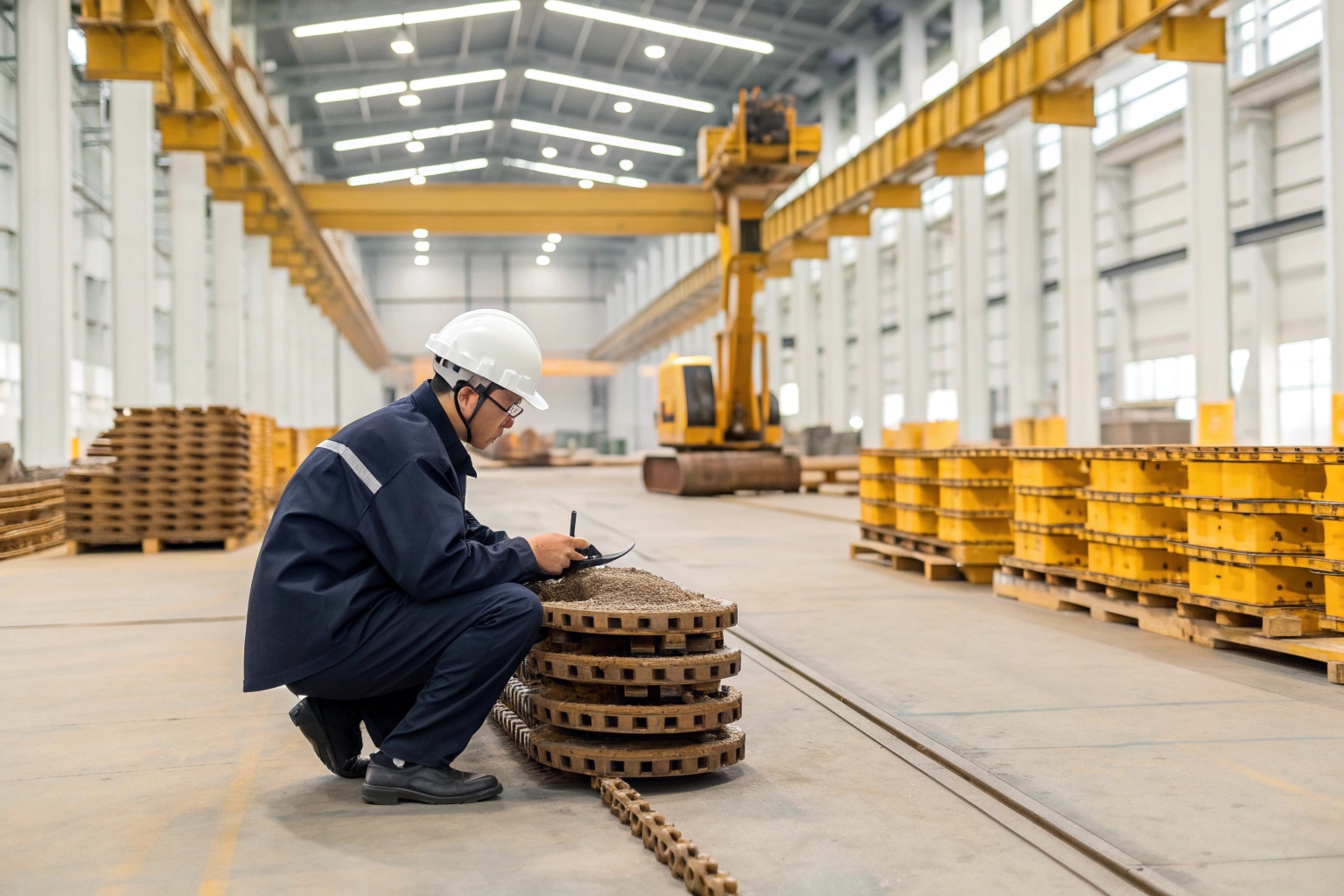
I know the frustration of scrolling through thousands of suppliers who all claim to be the "No.1 Factory" in China. You want reliable undercarriage parts for your customers, but the fear of bad quality or hidden middlemen keeps you up at night. I am Grace, and I will show you my proven method to filter out the noise.
To find and screen quality factories for excavator undercarriage parts, start by filtering for "Verified Suppliers" on Alibaba and checking their business license for "Production" scope. Then, cross-reference their engineering team on LinkedIn to validate their expertise. Finally, always demand a live video walk-through and third-party inspection to confirm physical capabilities before paying.
Sourcing is not just about finding a seller; it is about finding a partner who values your reputation as much as you do. If you skip these vetting steps, you risk delayed shipments and broken parts. Below, I will guide you through the exact steps I would take if I were in your shoes.
Which search keywords bring top manufacturers?
Most buyers type a generic word and hope for the best, but this usually leads to thousands of trading companies. If you do not use the right terms and filters, you will waste weeks talking to salespeople who have never stepped foot in a factory.
You should use specific keywords like "excavator undercarriage parts" or "track shoe assembly" and immediately apply the "Verified Supplier" filter. Look for companies with ISO 9001 certification and at least 10 years of history. Most importantly, verify that their business license lists "Production" or "Manufacturing" in the business scope, not just "Sales."

When I look at my competitors on Alibaba, I see many companies that look professional but are actually just offices in a city center. To find a real manufacturer like Dingtai, you need to use specific "industry language" and look for evidence that they actually make the product.
Decoding the Business License
The most powerful tool you have is the Chinese Business License 1. Every company on Alibaba has one, and you can usually find it in their profile or ask for it. The key is to look at the "Business Scope" line.
- Real Factory: The scope will include words like "Production" (生产), "Manufacturing" (制造), or "Processing" (加工).
- Trading Company: The scope will only list "Wholesale" (批发), "Sales" (销售), or "Import and Export" (进出口).
If a supplier refuses to show you this, or if the license only says "Sales," you are likely dealing with a middleman. This is not always bad, but if you want direct control over quality and price, you need the factory. A trading company often adds 10-20% to the cost and can rarely solve technical issues quickly because they have to relay messages back and forth.
Use Material Keywords as a Test
Another way to filter suppliers is to ask technical questions early on. Do not just ask "How much?" instead, ask about the steel. For example, when sourcing track rollers 2, ask: "Do you use 50Mn or 35MnB for the roller body?"
- Top Manufacturers: We will almost always recommend Boron steel 3 (35MnB). We know that Boron steel has better hardenability and wear resistance for heavy-duty excavators.
- Low-Quality Sellers: They might push 50Mn (Carbon Steel) because it is cheaper, or they might not know the difference.
The "Manufacturer" Label Trap
Alibaba labels some companies as "Manufacturers," but this system is not perfect. Sometimes a small workshop gets this label, but they cannot handle large orders. You need to combine the platform label with your own checks.
Here is a comparison table to help you spot the difference:
| Feature | Real Factory (The Goal) | Trading Company (The Risk) |
|---|---|---|
| Business Scope | Includes "Production" or "Manufacturing" | Includes "Sales", "Wholesale", "Trade" |
| Location | Usually in industrial zones (e.g., Quanzhou 4, Jining) | Usually in commercial office buildings |
| Material Knowledge | Suggests specific steel grades (e.g., Boron Steel) | Gives vague answers or focuses only on price |
| Customization | Can modify dimensions or hardness | Sells standard products only |
| MOQ (Min Order) | Often higher (requires production setup) | Very low (sells from mixed stock) |
By using these specific keywords and checks, you narrow down a list of 1000 suppliers to perhaps 10 strong candidates. This saves you time and protects your business.
How do I vet certifications and factory photos?
Paperwork can be forged, and photos can be stolen from other websites. I have seen my own factory photos used by other companies on Alibaba. You need a sharp eye to tell the difference between a real production line and a staged image.
You must verify certificates like ISO 9001 by checking the certificate number in the issuing body’s official database, such as the CNCA in China. For photos, ignore polished studio shots and look for "messy" background details like raw materials, specific machinery brands, and consistent worker uniforms that match the company logo.
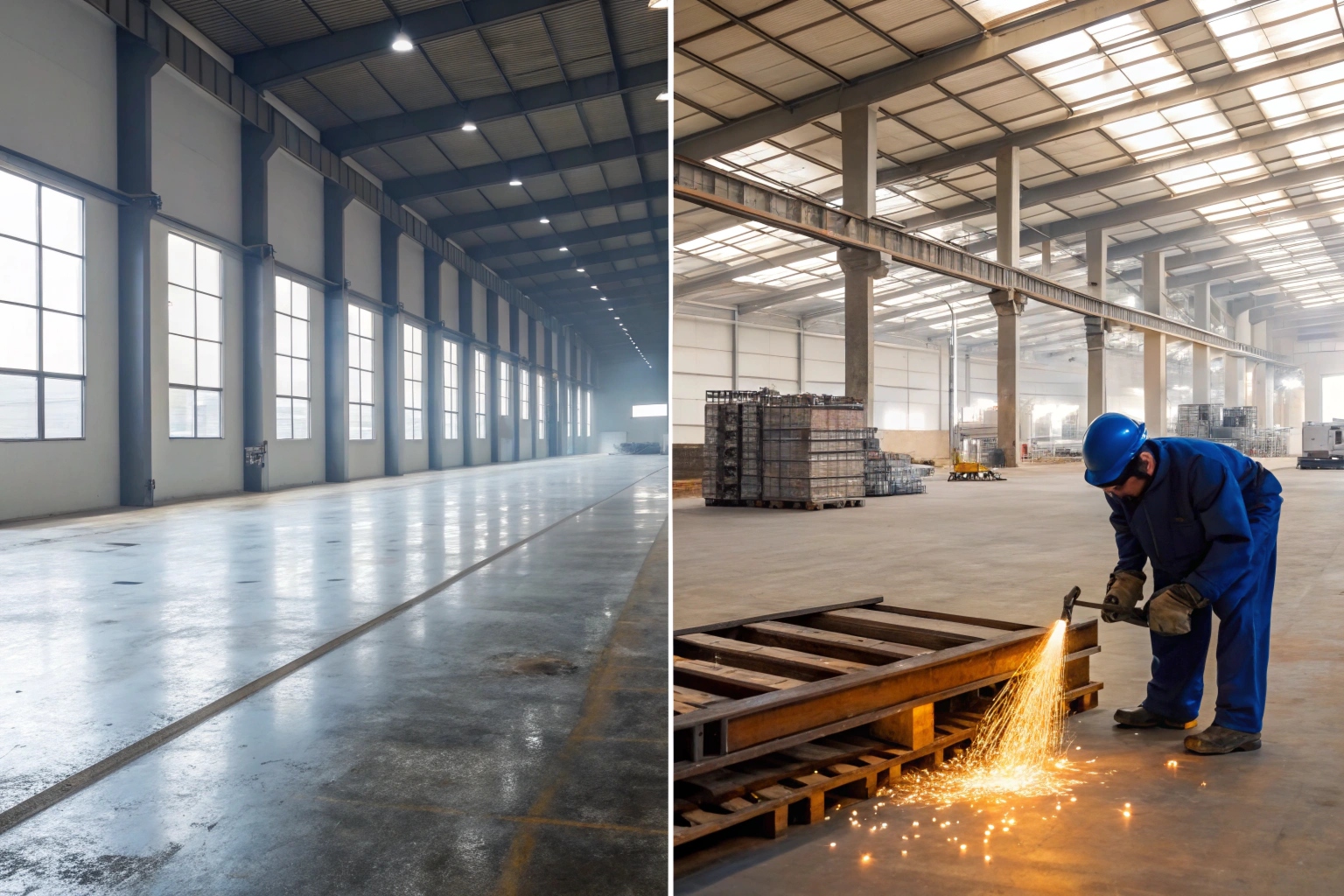
Certificates are the passport of a factory. They tell you that we follow a system. But a PDF file is not enough proof. You need to verify it.
Verifying the ISO 9001 Certificate
A real factory invests a lot of money and time to get ISO 9001 5 certified. It ensures we have a process for quality control. When a supplier sends you a certificate:
- Check the Expiry Date: Is it still valid?
- Check the Scope: Does it cover "Production of Undercarriage Parts"? Sometimes companies have a certificate for "Sales" only.
- Check the Database: Go to the website of the certification body (like SGS, TUV, or CQC). Input the certificate number. If no record appears, it is likely fake.
Analyzing Factory Photos
Do not trust perfect photos. Real manufacturing is dirty and loud. When you look at the photos in their Alibaba profile or the ones they send you, look for these clues:
- The Logo on the Wall: Is the company logo painted on the factory wall, or is it a banner that can be taken down? Painted logos show permanence.
- The Machines: Look for heavy machinery like friction welding 6 machines or heat treatment 7 furnaces. Trading companies might show photos of a warehouse, but they rarely show the actual forging or casting equipment.
- The Floor: Is there oil on the floor? are there metal shavings? This sounds negative, but it proves work is happening. A spotless floor often means it is a showroom, not a workshop.
The "Same Photo" Problem
If you see a photo that looks very familiar, use Google Image Search 8. Upload the photo. If it appears on five different company websites, then none of them likely own that photo.
I always advise my clients to ask for a "selfie" with the product. Ask the sales rep to write your name on a piece of paper, hold it next to the track chain or idler, and take a photo. A real factory can do this in 10 minutes. A middleman cannot.
Certification and Photo Checklist
Use this checklist when you are reviewing a supplier’s profile:
| Item to Check | What to Look For | Red Flag |
|---|---|---|
| ISO 9001 | Scope includes "Manufacturing" | Scope says "Trading" or "Sales" |
| Product Photos | Raw castings, semi-finished parts | Only painted, finished products |
| Background | Consistent factory signage | Blurred backgrounds or different logos |
| Date | Recent timestamps on photos | Photos look very old or low resolution |
Should I request live video tours before RFQs?
Emails and texts allow people to hide the truth. They can delay answers or ask someone else for help. A live video interaction is immediate and honest. It is the single best way to filter out dishonest suppliers before you even talk about price.
Yes, you should absolutely request a live video tour. Ask for an unscheduled video call during their working hours and ask the sales representative to walk onto the production floor immediately. This confirms they are physically at the factory and allows you to spot check inventory, machinery, and labor conditions in real-time.
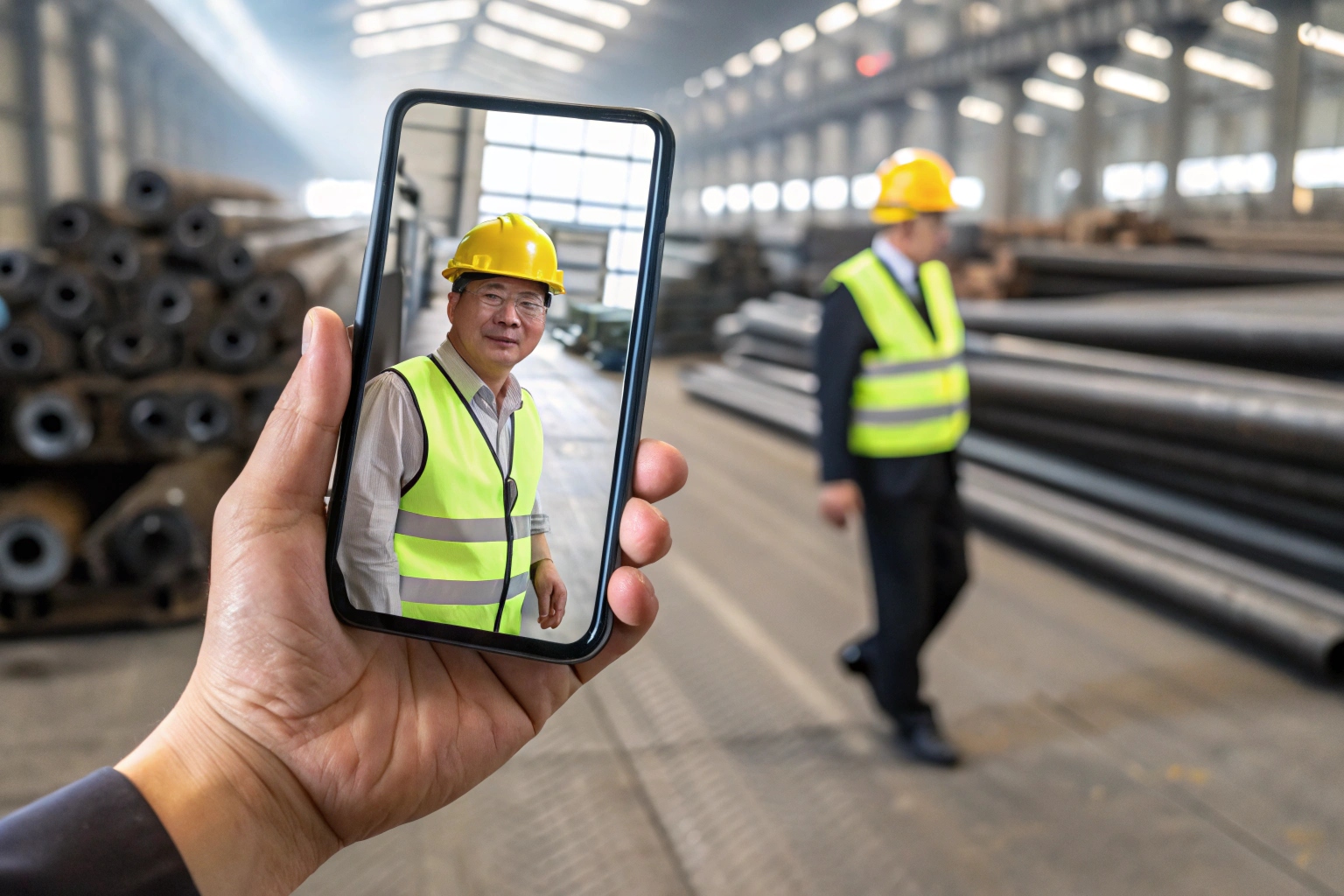
I actually love it when a customer asks for a video call. It gives me a chance to show off our automated lines and our stock. It builds trust instantly. If a supplier is afraid of a video call, ask yourself why.
The "Surprise" Element
Do not schedule the video call for next week. If you give them too much time, a trading company might drive to a partner factory and pretend it is theirs.
Instead, when you are chatting on WhatsApp or WeChat during China’s daytime (your evening), say: "I have a quick question about the production process. Can we do a 5-minute video call right now? I want to see the machine you use."
- Real Factory: "Sure, give me two minutes to put on my safety hat and walk to the workshop."
- Fake Factory: "Sorry, I am not at the factory today," or " The signal is bad," or "We need to apply for permission."
What to Look for During the Call
Once the video is on, you direct the camera. Do not let them just show you a meeting room.
- The Stock: Ask them to show you the warehouse. Do they have raw materials (steel bars) or just finished boxes? Real factories have huge stocks of raw steel.
- The Workers: Are people working? Do they look like they know what they are doing?
- The Noise: You should hear hammering, welding, or machines humming. Silence is suspicious.
- Specific Parts: Ask to see a specific part, like a "PC200 Track Roller." If they have to look for it for 20 minutes, they might not have stock.
Moving to Third-Party Inspection
The video call proves they are a factory. The next step, before you pay the balance, is a formal third-party inspection 9. You cannot visit China every time, but you can hire companies like SGS, Intertek, or V-Trust. For a few hundred dollars, they will send an engineer to my factory.
They will check:
- Dimensions: Does the roller fit the drawing?
- Hardness: They will cut a sample and test the heat treatment depth.
- Quantity: Is everything there?
This is standard practice for my big clients like David. It keeps us honest and gives you peace of mind.
Live Video Audit Scorecard
| Observation | Good Sign (Real Factory) | Bad Sign (Trader/Agent) |
|---|---|---|
| Response Time | Can start video in <15 mins | Delays or refuses call |
| Location | Sales office is inside/near factory | Sales office is in a high-rise city building |
| Interaction | Sales rep knows the workers | Sales rep seems like a stranger to workers |
| Details | Can show specific machinery close-up | Camera stays far away or blur is used |
Can I cross-check references on LinkedIn?
Alibaba is a marketplace, but LinkedIn is a professional community. It reveals the human side of the company. A company can fake a product listing, but it is very hard to fake a network of real employees and years of industry activity.
You can and should cross-check references on LinkedIn by searching the company name to verify their employee structure. Look for profiles of engineers and QC managers, not just sales staff, and check for posts about trade shows like Bauma or CONEXPO. Active engagement with other industry players is a strong sign of a legitimate business.
I use LinkedIn every day to connect with customers and share updates about Dingtai. If a supplier has zero presence on LinkedIn, or if their page is empty, it makes me wonder if they are serious about the global market.
Finding the Technical Team
When you search for a supplier on LinkedIn, go to the "People" tab.
- The Red Flag: If you only see profiles with titles like "Sales Manager" or "Account Executive." A factory cannot run with only salespeople.
- The Green Flag: You see profiles for "General Manager," "R&D Engineer," "Production Manager," or "Quality Control Specialist." This shows a full organizational structure.
Click on the profiles of the engineers. Do they have a work history? Do they post about technical topics? Real technical experts often share photos of problems they solved or new designs they created. For example, our chief engineer often shares articles about heat treatment curves. This shows that we are nerds about quality, not just salesmen.
Checking for Industry Presence
Reliable manufacturers are proud of their work. We post photos when we ship containers, when we install a new machine, or when we attend a big exhibition.
Look for posts about:
- Exhibitions: Photos from Bauma 10 Germany, Bauma China, or CONEXPO Las Vegas. Look for their booth number in the photo. It proves they invest in their brand.
- Shipping: Photos of containers being loaded. This proves they have active customers.
- Testing: Videos of a hardness test or a pressure test.
Reaching Out for References
You can even use LinkedIn to find their other customers. Look at who comments on their posts. If you see a user from a construction company in Australia commenting "Great job," you can message that person privately.
Ask them: "Hi, I see you follow [Supplier Name]. Have you bought from them? How was the quality?"
Most people are happy to share their experience. This is the most honest feedback you will ever get. It bypasses the salesperson completely. If a supplier is difficult to work with, other buyers will warn you. If they are great, like we strive to be, they will recommend them.
Conclusion
Finding a partner for undercarriage parts is not about luck; it is about following a strict process. Start with precise keywords and business license checks on Alibaba to find real producers. Use LinkedIn to verify their team and market presence. Finally, never skip the live video tour and third-party inspection. If you follow these steps, you will filter out the pretenders and find a factory like ours that is ready to support your growth for years to come.
Footnotes
1. Guide to understanding and verifying Chinese business licenses. ↩︎
2. Explanation of track rollers within continuous track systems. ↩︎
3. Properties of boron steel used in heavy machinery. ↩︎
4. Overview of Quanzhou, a major manufacturing hub. ↩︎
5. Details on ISO 9001 quality management standards. ↩︎
6. Technical explanation of the friction welding process. ↩︎
7. Overview of heat treatment processes for metal hardening. ↩︎
8. Tool for reverse image searching to verify photos. ↩︎
9. Benefits of independent third-party quality inspections. ↩︎
10. Official site for Bauma, the leading construction trade fair. ↩︎